


Respect Through Remembrance: A Visit to Auschwitz
- Olivia Mack
- Apr 9, 2019
- 6 min read
“Work sets you free” reads the sign above the entrance to the Auschwitz concentration camp. A cruel joke, the tour guide informs us, as the only way for the prisoners to actually be free was through the crematorium chimney.
This weekend Zoe and I visited Krakow, Poland for our final full-length free weekend. During the planning stages we were both hesitant to share our interest in visiting Auschwitz. It felt like such a terrible thing to say that this was a place I wanted to go--not just as another tourist site to see, but as a way to reflect on the past and pay respect to the millions of people who senselessly lost their lives to the Holocaust.

On Saturday afternoon, we found ourselves in a group of about twenty people in a very large van enroute to Oswiecim (“Auschwitz” was the German name given to this Polish town). The drive took a little over an hour and we were occupied by a video giving a little more background to what we were about to see. This video explained, first of all, that Auschwitz was not only one camp, but actually a complex of three camps and a small industrial area.
At the entrance to the first camp, there was strict security with metal detectors and bag scanning machines. Any sort of bag brought in had to be the size of a sheet of paper or smaller which meant I had to leave my backpack behind on the bus. Once through security, we were given head phones so that we could hear our guide from a distance away. Honestly, these didn’t work all that great and kept cutting out, but it was a good idea!! Our guide then introduced us to our second guide who only spoke Polish. She would begin by explaining an area or picture, then the first guide would translate into the headphones. And this is where the tour began.


The gloomy afternoon with a near constant drizzle increased the ever-somber energy of the camps. The sky seemed to be weeping over the lost lives of the prisoners. If you told me the weather behaved this way every day, I would not question it. Going into the day, I expected to feel a constricting weight cast over me throughout the whole camp. This was present in some areas, like the basement of Block 11, the death block, and inside of the only gas chamber that still stands. The rest of the camp didn’t feel quite so restricting but rather somber. Maybe this is representative of just how hopeless the prisoners felt.
In Auschwitz I, the first camp, many of the barracks had been transformed into museum exhibits. Each were dedicated to a different aspect of the prisoners lives while in the camp. In Block 5 was material evidence to prove the crimes within the camps’ operation. Basically, this was a building filled with the belongings of prisoners that had been seized and looted by the Nazis. I wasn’t ready for what I would find inside. Maybe it was because we had only been on the grounds for a little while at this point. Maybe it was because the tour guide did not inform us about what we were about to see. Maybe it was because the building we were in had been completely renovated and disconnected from their former use. As we walked through the doorway and the guide chatted about different bits of history in our headphone set, I was completely off put by the room behind glass piled full of hair. Human hair, still in braids and ponytails. I have seen the shoe display in the Holocaust museum in Washington D.C., and I remember how compelling it felt to have such tangible evidence of the people who experienced the camp directly in front of me. Now, the piles and piles of hair which sat in front of me were direct pieces of the people. 7,000 kilograms of hair was extracted from the camp after liberation. Can you even imagine how many people this belonged to? Can imagine how many more kilograms were used or destroyed? It is a horrifying thought.

As we went from to block to block learning about the horrors that the prisoners experienced, it was remarkable to see how careless the other visitors were to what ought to be revered as sacred ground. Many of them walked around only seeing this place through their phone camera screens. Pictures were taken in the most disrespectful manner throughout the camp, starting with smiling for the camera underneath the taunting entrance sign. Photos were snapped within the basement of Block 11 where pictures were not even allowed, and thousands of people were put in trial, tortured and murdered by the Gestapo police. Even the only remaining gas chamber was the subject for many quickly-snapped photos and mindless walk-throughs. I could not begin to understand what possesses someone to think it would be appropriate to walk into the concrete walls of the gas chambers where thousand upon thousands of people were killed and act with anything but reverence and respect. It was frustrating and disrespectful to see others treat the camp as any other tourist attraction. What does this imply that people think of the Holocaust in the modern day?

After this, we were loaded back onto the bus and brought about five minutes away to Auschwitz-Birkenau. There was big difference between the two camps. Auschwitz I was a former Polish army camp that had been converted into a concentration camp. It was relatively small and complete with renovated interiors to serve as exhibition space. Birkenau was the expansive extermination camp built by the prisoners of Auschwitz. It was largely just a field with a fence and a few buildings left standing. It was easy to picture what it would have looked like as chimneys to the barracks peppered the landscape with each two representing a single barrack to house at least 400 people. The original rail track led up to a symmetrical building with a tower at the center. Trains would pass underneath and deposit prisoners onto the ramp where their possessions were taken from them and they were sorted into two groups--those to go to work and those to go “shower.” Most wouldn’t live to see the interior of the camp.
There was an eerie energy to the air as the sun lowered leaving a murky sky. Crows circled above our heads, cawing. Dusk was beginning to fall. We walked the path of many toward the back of the camp. At the beginning of the day, our guides showed a map of all the camps and pointed out where each of the crematoriums were located. He mentioned that, “Unfortunately, crematoriums two through five had been destroyed by the Nazis” to rid the place of the evidence of what happened there. I understand he was calling this “unfortunate” in reference to the fact that we would not be able to see or walk through these buildings, but at the time, the comment seemed odd to me. Now, as we approached the piles of brick with frayed rebar poking out here and there, it was obvious the guide’s comments were very wrong. The gas chambers lying in ruins was not an unfortunate sight, but rather a liberating one. There was a sense of justice to see this place where an unfathomable amount of death and destruction to people took place transformed into merely rubble.


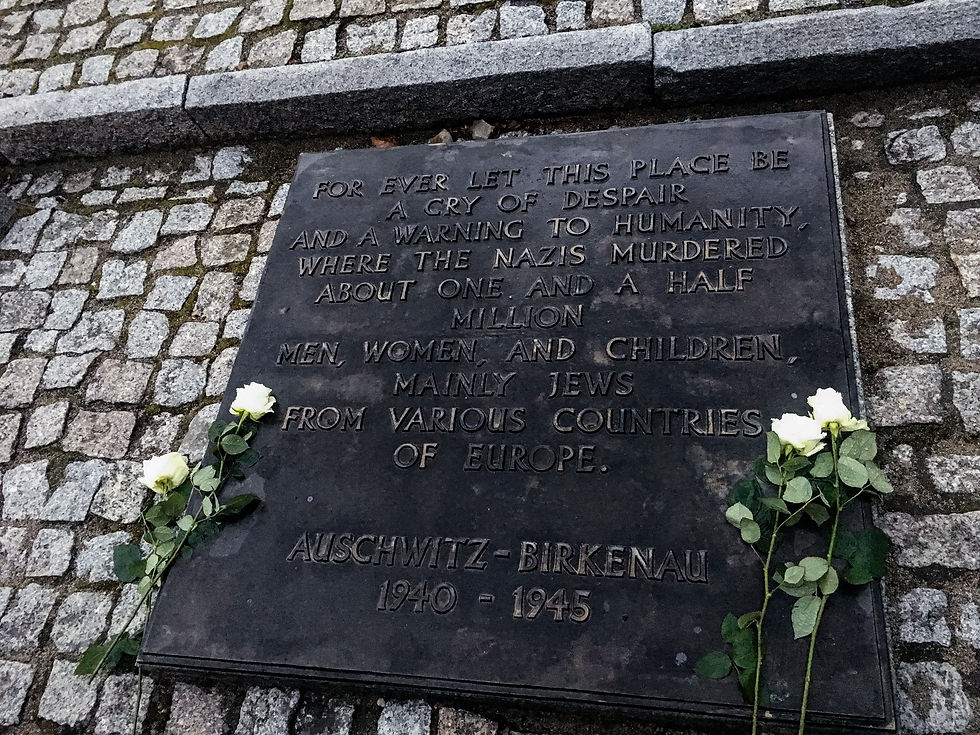
From 1940-1945, 1.1 million people were murdered in Auschwitz alone. That is not counting the deaths at any of the other camps scattered across Europe, and these are only the deaths which were properly recorded. As fellow human beings it is our responsibility to remember this event and do what we can to prevent anything like it from happening again. Elie Weisel, author of the Novel Night and holocaust survivor said, “the opposite of love is not hate, but indifference.” Hate exists in every corner of the world, still today, nearly 80 years later. If we do not actively stand up to hatred and dehumanization, but rather approach it with indifference, there is no guarantee that a tragedy this monumental could not happen again. How will we ensure that this time, history does not repeat itself?


Comments